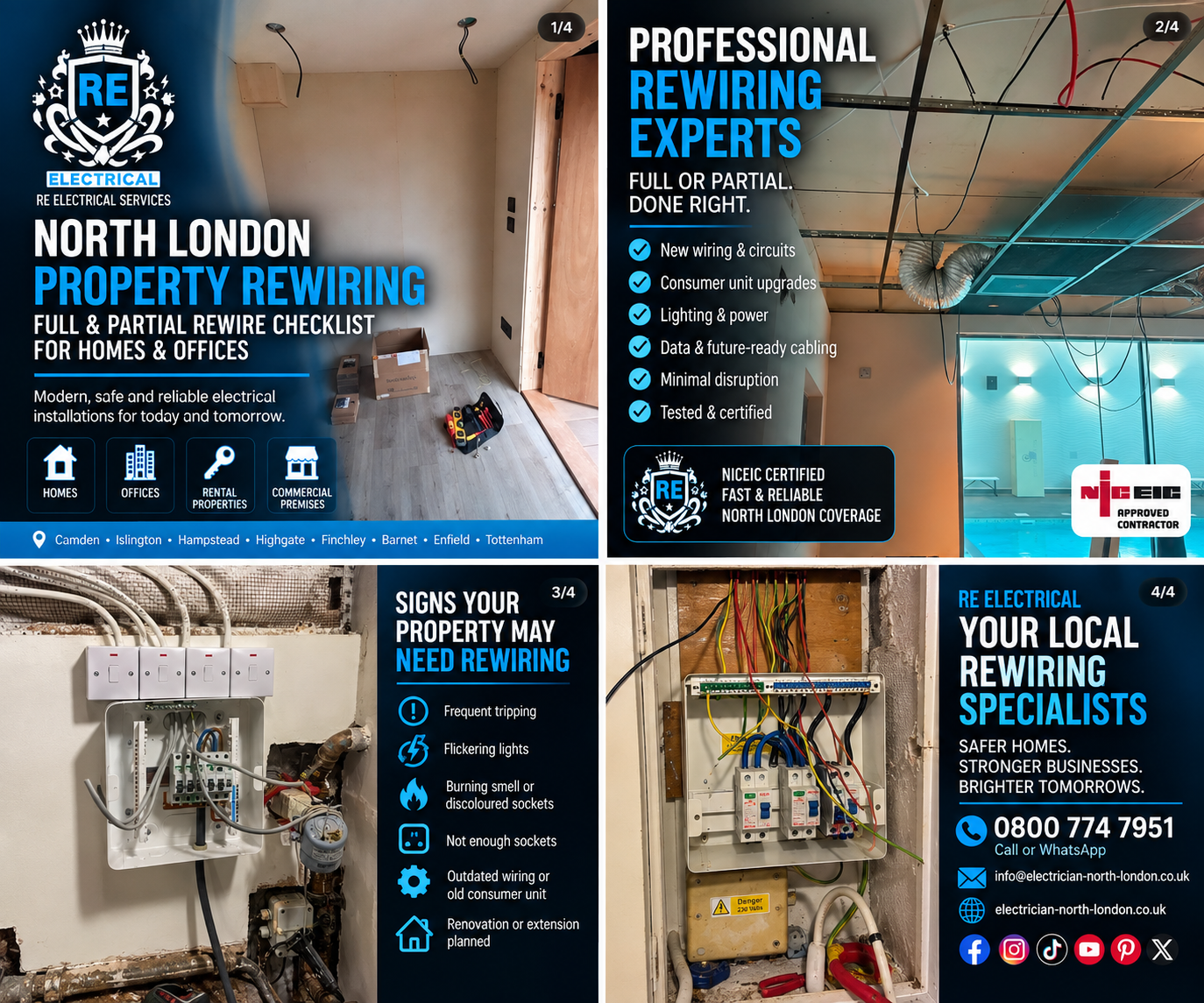
North London property rewiring projects should start with one important question: does the property really need a complete rewire, or would a carefully planned partial rewire solve the problem? Whether you own a home, manage a rental property or oversee an office or commercial unit, the key is understanding what needs rewiring, why, and how much of the electrical installation should be replaced.
RE Electrical provides NICEIC-certified, fast and reliable full and partial property rewires across North London, including Camden, Islington, Hampstead, Highgate, Finchley, Barnet, Enfield and Tottenham. The process starts by assessing the existing installation, how the property is currently used and what future electrical demand is likely to be.
If you already know the property needs upgrading, visit our full and partial rewiring services in North London page to request an assessment or quotation.
Electrical safety warning: if you smell burning, see smoke or sparks, discover exposed live wiring, receive an electric shock or believe there is an immediate danger, stop using the affected area where safe and contact an emergency electrician in North London.
A full property rewire normally means replacing most or all fixed wiring and circuits throughout the property. It may also include new sockets, switches, lighting points and a consumer unit upgrade where required. Full rewires are often considered where wiring is extensively outdated, unsafe, heavily altered or unsuitable for modern electrical demand.
A partial rewire targets defined sections or circuits: for example, a kitchen refurbishment, one floor, a damaged lighting circuit, an extension or part of a commercial unit where the remaining electrical installation is still serviceable.
Age alone does not prove that a building needs rewiring. Electrical Safety First says the condition of the installation matters and identifies warning signs including burn marks, buzzing or crackling, repeated circuit-breaker trips and visibly old wiring. Read Electrical Safety First guidance on older wiring and rewiring.
Before deciding on a full house rewire or partial rewire, establish what is already there. A competent electrician should consider the consumer unit, protective devices, earthing and bonding, cable condition, circuit arrangements, sockets, switches, lighting points and any signs of overheating, damage or poor previous alterations.
An EICR and electrical testing service can provide useful evidence about the condition of fixed wiring. An unsatisfactory EICR does not automatically mean a complete rewire is required, but it can identify defects needing investigation or remedial work.
A full rewire may be appropriate where problems affect multiple circuits, the installation contains extensive outdated wiring, deterioration is widespread or a major refurbishment exposes most of the property anyway.
A partial rewire may suit a defined area where the rest of the installation has been inspected and remains satisfactory.
Ask for the reason behind the recommendation. Property owners and landlords should be cautious of any full-rewire proposal that does not explain why targeted remedial work would be insufficient.
Think beyond today's socket count. Consider home offices, induction cooking, electric showers, EV charging, heat pumps, garden rooms, security systems, additional refrigeration, air conditioning or increased workstation density in offices.
Planning these requirements during rewiring is normally easier than opening walls again later. If additional circuits or higher electrical loads are planned, RE Electrical can assess whether a consumer unit replacement or electrical upgrade should form part of the work.
Walk through each room before work starts and mark where beds, desks, televisions, kitchen appliances, wardrobes, retail displays or office workstations will sit.
Confirm socket quantities, data requirements, lighting zones, two-way switching, outdoor power, extractor fans, smoke and heat alarms and any smart-home controls.
For rental properties, practical electrical layouts can help reduce dependence on extension leads and make rooms more flexible for future tenants.
A rewire is not only about replacing cable. The completed installation needs appropriate circuit protection and a properly designed distribution arrangement. Depending on the existing board and project scope, the consumer unit may also need upgrading.
Domestic rewiring can include work that is notifiable under Building Regulations Part P, particularly new circuits, consumer unit replacement and certain work in special locations. GOV.UK's Approved Document P electrical safety guidance explains the requirements applying to electrical work in dwellings.
Rewiring can involve floors, walls, ceilings, voids and service routes. Before work begins, clarify which rooms need clearing, whether flooring must be lifted, where wall chases may be required, how dust will be controlled and what making-good work is included.
This is particularly important for occupied rental properties, offices and commercial premises. Phasing work by floor, zone or circuit can sometimes reduce disruption.
For workplaces, RE Electrical's office electrical maintenance service can also support planned electrical upgrades around operational requirements.
The best time to rewire is often when a property is already being refurbished. Kitchens, bathrooms, loft conversions and extensions can significantly change electrical demand and cable routes.
Coordinate the electrician with builders, plumbers, kitchen installers, ceiling contractors and decorators before walls and ceilings are closed. This helps avoid unnecessary rework and allows power, lighting, ventilation and appliance requirements to be planned together.
Landlords in England have specific electrical safety responsibilities. Current GOV.UK guidance requires covered rented properties to have the electrical installation inspected and tested by a qualified person at least every five years, with the resulting electrical report supplied as required.
A property rewire can address defects identified during inspection, but the project should also finish with the appropriate testing and documentation.
Landlords and property managers should review the GOV.UK electrical safety guidance for landlords and retain relevant electrical reports and certificates with their property compliance records.
For offices, shops, hospitality venues and managed commercial buildings, rewiring decisions need to consider business continuity as well as electrical safety.
Identify which circuits are business-critical, whether the work can be phased and when electrical isolation can take place without unnecessary disruption to employees, tenants, customers or essential equipment.
The Health and Safety Executive states that electrical installations should be maintained to prevent danger. See RE Electrical's commercial electrician services in North London and the HSE's workplace electrical safety guidance.
Do not treat a rewire as complete simply because the final socket has been fitted.
Confirm what testing will be carried out, what electrical certification will be provided, whether circuits and the consumer unit will be clearly labelled and what documentation should be retained for landlords, insurers, buyers, property managers or future electricians.
Reasons to arrange a professional rewiring assessment include repeated tripping, flickering lights, hot or discoloured sockets, buzzing or crackling, damaged electrical accessories, insufficient sockets, an outdated consumer unit, visible old cable types, unreliable DIY alterations, an unsatisfactory EICR or a major renovation that will substantially change how the property uses electricity.
Older North London terraces, period houses, converted flats and mixed-use buildings may contain layers of electrical work completed during different decades.
That does not mean every older property automatically needs a full rewire. It does, however, make professional inspection particularly valuable before refurbishment, purchase, letting or major electrical upgrades.
For homeowners, a full house rewire can be an opportunity to improve more than electrical safety. It can also modernise the way the home works.
A planned rewire can introduce additional socket outlets, dedicated appliance circuits, improved lighting layouts, outdoor power, data points, smart controls and capacity for future technologies.
Where only part of the property is being renovated, a partial rewire in North London may provide a more proportionate solution, subject to the condition of the remaining installation.
For landlords and managing agents, electrical work often needs to balance safety, compliance, tenant disruption and long-term maintenance.
An EICR may identify specific remedial requirements rather than a complete replacement of the installation. In other cases, repeated defects, extensive legacy wiring or a major refurbishment may make a broader rewire more practical.
The important point is to base the decision on inspection and testing rather than assumption.
RE Electrical provides full and partial rewires for homes, flats, rental properties, offices and commercial premises, alongside consumer unit upgrades, EICR testing, electrical maintenance and emergency electrical services.
Coverage includes Camden, Islington, Hampstead, Highgate, Finchley, Barnet, Enfield, Tottenham, Wood Green and surrounding North London areas. Check whether your property is covered through the RE Electrical areas covered page.
The aim is not to recommend a complete rewire where a properly assessed partial rewire or targeted remedial repair would solve the problem. It is to provide a clear scope, a safe electrical installation, appropriate testing and documentation, and a practical electrical system designed for the way the property will actually be used.
If electrical defects are widespread or most circuits are outdated or deteriorated, a full rewire may be appropriate. If the problem is limited to a defined area and the remaining installation is satisfactory, a partial rewire may be enough.
No. Age is an indicator rather than a diagnosis. Wiring type, condition, previous alterations, protective devices and inspection results all need to be considered.
Potentially, yes, provided the completed installation is safe and the remaining installation is suitable for continued service. The decision should be based on proper electrical inspection and testing.
Yes. RE Electrical supports offices, shops and managed buildings across North London, with projects planned around electrical demand, testing, access and operational requirements.
Not automatically. The existing consumer unit should be assessed. If it is unsuitable for the new installation, additional circuits or required protection, an upgrade can be incorporated into the rewiring project.
If you are planning a renovation, responding to an unsatisfactory EICR, upgrading an older property or deciding between a full and partial rewire, RE Electrical can inspect the installation and explain the available options clearly.
RE Electrical — NICEIC Certified • Fast & Reliable • North London Coverage
Phone & WhatsApp: 0800 774 7951
Email: info@electrician-north-london.co.uk
Website: electrician-north-london.co.uk
Request a North London property rewiring assessment or contact RE Electrical to discuss your property, planned refurbishment, EICR findings or electrical upgrade requirements.

Why Your Fuse Box Keeps Tripping: North London Electrician Troubleshooting Guide If your fuse box keeps tripping in North London,...
Electrical rewiring in London is a vital service for homeowners looking to ensure safety, efficiency, and compliance with modern electrical...

The Ultimate Guide to Electrical Rewiring London: Essential Safety for Your Property Table of Contents Introduction: The Hidden Dangers in...