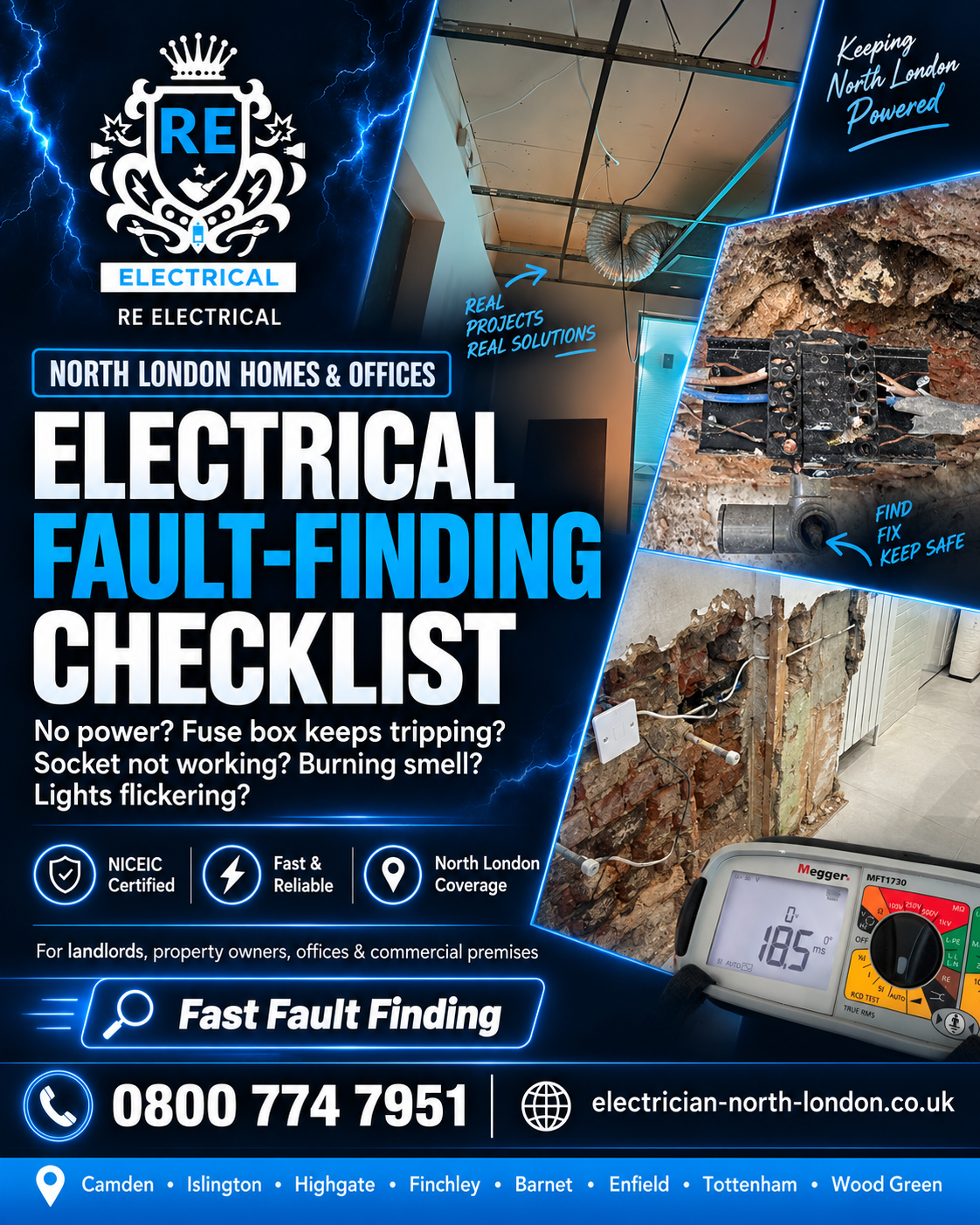
No power? Fuse box keeps tripping? A socket suddenly stopped working? Noticed a burning smell from the electrics? Are your lights flickering for no obvious reason?
These are electrical warning signs that should not be ignored. For landlords, homeowners, property managers and businesses, arranging professional electrical fault finding London services can help identify where the problem originates before a recurring fault develops into a more serious safety issue, prolonged power outage or disruption to a property.
RE Electrical provides fast and reliable, symptom-led electrical fault finding for homes, rented properties, offices and commercial premises throughout London. Our electricians investigate the actual cause rather than simply resetting a breaker and hoping the problem disappears.
If you need immediate diagnosis, see our electrical repairs and fault finding in London service.
Important: If you can smell burning, see smoke or sparks, find exposed wiring, receive an electric shock or believe there is an immediate electrical danger, stop using the affected equipment or area where it is safe to do so and contact a qualified electrician urgently. For an urgent call-out, contact our emergency electrician in London.
Electrical faults do not always announce themselves with a complete blackout. Often, the first clue is a symptom: one socket stops working, lights begin flickering, an RCD trips repeatedly or a tenant reports an unusual smell.
Use the following seven-point electrical fault-finding checklist as an early-warning guide.
A search for a “no power electrician London” often happens when someone needs help immediately. Before assuming there has been a network-wide power cut, establish whether neighbouring properties are affected and whether the loss of power involves the entire property or only one circuit.
If only certain rooms, sockets or appliances have lost power, the problem could relate to a tripped protective device, faulty appliance, damaged circuit, loose electrical connection or another installation fault.
Repeatedly resetting a breaker without understanding why it operated is not a proper repair. Protective devices are designed to respond when particular electrical conditions occur. When power repeatedly disappears, professional testing can help identify the underlying cause.
Where the loss of electricity is urgent or occurs outside normal working hours, RE Electrical also provides 24-hour electrical services in London.
One of the most common symptom-led searches is “fuse box tripping electrician” or “RCD keeps tripping electrician near me”.
A breaker that trips once may have reacted to a temporary problem. A consumer unit, circuit breaker or RCD that continually trips deserves investigation.
Possible causes can include overloaded circuits, faulty appliances, damaged wiring, moisture, insulation faults, defective accessories or problems within the consumer unit itself.
Do not repeatedly force a circuit back on when it immediately trips again. Instead, arrange fault diagnosis. RE Electrical provides dedicated fuse box and consumer unit repairs in London, including investigation of tripping circuits and power-loss problems.
Electrical Safety First also advises consumers not to ignore circuit breakers that repeatedly trip, burn marks, unusual heat or arcing-type sounds.
If you are searching for a “socket not working electrician”, first consider whether the problem affects one socket, several outlets or an entire circuit.
A dead socket may result from something relatively localised, but it can also indicate a circuit problem requiring electrical testing. Warning signs become more urgent if the socket is cracked, discoloured, loose, buzzing, sparking or unusually warm.
Landlords and property managers should encourage tenants to report these symptoms promptly rather than continuing to use a questionable socket through an extension lead or adaptor.
Where safe, stop using damaged electrical accessories until they have been inspected. Avoid removing socket fronts or attempting DIY electrical diagnosis.
A search for “burning smell electrics” should be treated differently from a routine maintenance enquiry.
A burning or hot-plastic smell around a socket, switch, light fitting, appliance connection or consumer unit can indicate overheating or another potentially dangerous condition.
Do not ignore the smell because the electricity still appears to work. Stop using the affected item or area where this can be done safely and arrange urgent professional assessment.
If there is visible smoke, fire or an immediate danger to occupants, leave the affected area and contact the appropriate emergency services. Do not attempt to investigate live electrical components yourself.
For suspected dangerous electrical faults, use RE Electrical's London emergency electrician service.
People searching “lights flickering electrician near me” are usually describing a symptom rather than knowing its technical cause.
An individual lamp may simply need attention, but persistent flickering across a circuit, several rooms or the wider property can warrant investigation. Depending on the circumstances, causes may involve the fitting, switch, circuit connections, loading or another part of the electrical installation.
Pay particular attention when flickering happens alongside buzzing, heat, burning smells, regular breaker trips or unexplained power interruptions.
For landlords managing older conversions, HMOs or properties that have undergone numerous alterations, recurring symptoms across different circuits may also justify broader inspection rather than repeated isolated repairs.
Electrical installations should not routinely produce unexplained buzzing, crackling, visible arcing or signs of overheating.
If these symptoms appear around a socket, switch, light fitting or consumer unit, avoid continuing to use the affected component until it has been assessed.
This is particularly important in managed properties because one occupant may notice a symptom that others have previously overlooked. Property managers should have a clear process for recording electrical complaints, identifying whether there is an immediate danger and arranging competent investigation.
A good fault-finding visit is not simply about replacing whatever component looks suspicious. The electrician should diagnose why the symptom occurred and determine whether the issue is isolated or points to a broader circuit or installation problem.
Repeated fault reports should not become background noise.
A tenant who reports that “the kitchen sockets keep going off”, an office manager experiencing repeated lighting failures or a shop manager continually resetting a breaker may be describing an unresolved underlying fault.
For landlords, this is also an important property-management issue. Current electrical safety requirements in England require relevant rented electrical installations to be inspected and tested by a qualified person at prescribed intervals, generally at least every five years, while reported safety issues can require attention sooner.
RE Electrical provides dedicated landlord EICR services in London for landlords, letting agents and property managers who need formal inspection, reporting and assistance understanding remedial requirements.
Fault finding is a diagnostic process. The objective is not to guess which accessory might be causing the problem but to identify the fault systematically, test the relevant circuit or equipment and establish an appropriate next action.
This distinction matters because similar symptoms can have different causes. A tripping breaker could relate to an appliance on one property and a wiring defect on another. A dead socket might represent an isolated accessory fault or form part of a wider circuit issue.
Correct diagnosis can therefore reduce unnecessary replacement work while ensuring genuine safety concerns are not hidden behind temporary resets or improvised fixes.
Depending on the findings, the solution might involve a straightforward electrical repair, replacement of a damaged accessory, circuit repair, consumer unit work, partial rewiring or further electrical inspection.
If the consumer unit itself needs modernisation, see our consumer unit replacement and electrical upgrade service.
Landlords need to think about electrical faults from both a safety and property-management perspective.
GOV.UK's current electrical safety guidance states that landlords covered by the regulations must ensure electrical safety standards are met, arrange inspection and testing of electrical installations by a qualified person at least every five years, obtain the resulting report and complete required investigative or remedial work.
An EICR can identify issues such as electric-shock risks, fire hazards, defective electrical work, overloading or inadequate earthing and bonding. However, a valid EICR should not become a reason to ignore a new electrical problem reported between scheduled inspections.
If a tenant subsequently reports a burning smell, damaged socket, regular power loss or repeated tripping, the sensible response is to assess the new symptom rather than simply point to the date of the last report.
That is why combining planned landlord electrical inspections with responsive fault finding can create a stronger electrical safety process for managed properties.
Electrical problems in offices have another consequence: downtime.
A circuit failure can affect lighting, computers, communications, kitchen equipment, access systems or other operational equipment. Facilities managers and office managers therefore need a response that balances safety with business continuity.
The Health and Safety Executive identifies electrical shock, burns, arcing and fire from faulty electrical equipment or installations among the principal workplace electrical hazards. It also advises that installations and electrical equipment should be maintained to prevent danger.
For workplaces, RE Electrical provides office electrical maintenance in London, including troubleshooting, socket and circuit testing, inspection and responsive repairs.
Businesses requiring broader support can also use our commercial electrician services in London.
RE Electrical serves homes, landlords, offices and commercial premises throughout London, including Camden, Islington, Hampstead, Highgate, Finchley, Barnet, Enfield, Tottenham, Wood Green and surrounding areas.
If you need an electrician close to the property, explore our London electrical service areas.
Our aim is straightforward: identify the cause of the electrical problem, explain the findings clearly and recommend the appropriate solution rather than leaving you with an unexplained recurring symptom.
RE Electrical — NICEIC Certified • Fast & Reliable • London Coverage
Possible causes include a faulty appliance, circuit overload, damaged wiring, moisture, defective accessories or another electrical fault. If the breaker repeatedly trips after being reset, arrange professional fault finding instead of continually resetting it.
It should be treated urgently. Stop using the affected electrical item or area where safe and arrange assessment by a qualified electrician. If there is smoke, fire or immediate danger, leave the area and contact the emergency services.
A failed socket can have several possible causes, ranging from an issue at the accessory to a circuit fault. Avoid DIY dismantling. If the socket is hot, discoloured, buzzing or damaged, stop using it and arrange an inspection.
Yes. An EICR records the condition of the installation at the time of inspection. New or reported electrical safety problems arising afterwards should still be assessed appropriately rather than ignored until the next periodic inspection.
Yes. RE Electrical provides commercial and office electrical fault finding, maintenance and repair services across London, helping facilities managers and businesses address outages, tripping circuits, socket problems and other electrical faults.
Not every flickering light is an emergency, but persistent flickering combined with burning smells, overheating, buzzing, sparks, electrical shocks or repeated tripping should be treated seriously. If you are unsure about the level of risk, contact a qualified electrician for advice.
If you are dealing with no power, a fuse box that keeps tripping, a socket that has stopped working, a burning electrical smell, flickering lights or another unexplained electrical fault, do not rely on guesswork.
RE Electrical provides fast, reliable electrical fault diagnosis and repairs for homeowners, landlords, property managers, offices and commercial premises across London.
Contact RE Electrical:
Phone & WhatsApp: 0800 774 7951
SMS: 07930 412035
Email: info@electrician-north-london.co.uk
Book electrical fault finding in London or contact RE Electrical to discuss the symptoms you are experiencing.
If you smell burning, see smoke, experience an electric shock or believe there is an immediate electrical danger, treat the situation as urgent.