If you manage, own, or let office space in London, electrical maintenance should never be treated as an afterthought. For landlords, property owners, asset managers, and facilities teams, a well-planned maintenance routine helps reduce disruption, supports tenant satisfaction, improves safety, and makes it easier to stay ahead of faults before they become expensive operational problems. That is why a clear commercial electrical maintenance London strategy matters so much for modern office buildings.
For many commercial properties, the risk is not one dramatic failure. It is the slow build-up of smaller issues: worn sockets, overloaded extensions, emergency lighting that has not been tested properly, a fuseboard that no longer reflects the office layout, or portable appliances that are being used daily without any structured inspection plan. These are the types of issues that can affect downtime, staff confidence, landlord obligations, insurer expectations, and building presentation.
At RE Electrical, we support office landlords, commercial property owners, and building managers with commercial electricians in London, ongoing office maintenance, testing, fault finding, fuseboard upgrades, and responsive support across North London. RE Electrical positions itself as NICEIC-certified, local 24/7, and focused on efficient, reliable commercial electrical services for offices and business premises.
A good office maintenance plan is about more than compliance language. It is about keeping the property functional, safe, and professional. In a commercial office setting, electrical reliability affects everything from lighting and workstation productivity to meeting room usability, air-conditioning controls, reception presentation, and general business continuity.
For landlords and property managers, maintenance also helps protect asset value. A well-maintained office is easier to let, easier to manage, and less likely to generate urgent faults that disrupt occupants or require expensive reactive work. For facilities teams, a checklist approach creates visibility. It turns maintenance from something vague into something trackable.
That is why search terms such as office electrical maintenance, facilities electrician London, office EICR London, and commercial electrical checklist London reflect strong business intent. The user is usually looking for a contractor or a system that helps them keep an office running safely and efficiently.
Lighting is one of the first things office occupants notice when something is wrong. Flickering fittings, failed lamps, inconsistent brightness, or poorly distributed light can all affect productivity and how the workplace feels. For landlords and office managers, lighting issues are also highly visible signs of poor maintenance.
A commercial electrical maintenance checklist should therefore start with a review of:
The practical goal is simple: identify failed fittings, inconsistent levels, damage, outdated lamps, and any layout problems caused by office reconfiguration. This is particularly important in older office buildings where tenant changes, partitioning, and fit-out changes may have altered how the space is used over time.
Office sockets and small power points are used constantly, yet they are often only noticed when they fail. Loose faceplates, cracked outlets, overloaded trailing extensions, scorched accessories, and poor placement around desks are all common office issues. For landlords and property owners, they also create a clear maintenance and presentation problem.
As part of your office electrical maintenance routine, inspect:
Repeated use of extension leads often indicates that the office power layout no longer matches the occupancy pattern. That is not just inconvenient. It can signal that the space needs a more strategic upgrade rather than repeated short-term fixes.
Portable appliances are a major part of office life. Monitors, kettles, desk fans, chargers, floor lamps, extension leads, docking stations, and cleaning equipment all fall into the wider picture of electrical maintenance. The important point is not to treat PAT as a box-ticking exercise. The smarter approach is to build portable equipment checks into an actual risk-based maintenance plan.
For useful background on this, see HSE’s guidance on maintaining portable electric equipment in low-risk environments. That is highly relevant for offices because it explains a sensible approach to maintaining portable electrical equipment in low-risk workplaces rather than assuming everything always needs the same type of formal test.
In practical terms, your checklist should include:
For offices, this is where working with a facilities electrician London businesses trust can help bring structure to what often becomes an inconsistent internal process.
While day-to-day checks matter, fixed-installation condition is still central to safe office operation. A commercial property may appear to be functioning normally and still have underlying issues within the fixed wiring, protective devices, distribution arrangements, or previous alterations. That is why periodic inspection and testing should sit within a broader maintenance plan for any office building.
For landlords and property managers, a structured approach to commercial electrical testing and certification helps create a more reliable evidence trail for tenants, insurers, internal compliance records, and planned remedial works. It also gives a clearer picture of whether issues are isolated or part of a broader deterioration pattern.
Your checklist should include:
This is especially relevant in office buildings where space use changes regularly. Reconfigured layouts, added workstations, new kitchen equipment, air-conditioning controls, and upgraded IT loads can all change the demands placed on the electrical system.
Emergency lighting is easy to overlook when everything appears normal. But from a building-safety perspective, it is one of the most important systems to keep in proper working order. In an office environment, escape routes, stairwells, corridors, and key common areas all depend on emergency lighting functioning correctly if mains power fails.
Your checklist should include:
This is a strong area for proactive maintenance because emergency lighting failures often remain hidden until testing takes place. For landlords and office operators, that makes regular review far more valuable than relying on assumptions.
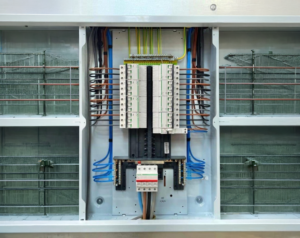
Fuseboards and distribution equipment are at the core of any commercial electrical maintenance London plan. In office settings, these are often tucked away in cupboards or risers, which means they can be forgotten for long periods. But they should still be reviewed for signs of age, poor labelling, circuit overloading, unauthorised additions, or limited capacity following office changes.
Your maintenance checklist should include:
Where the board is no longer suitable, the next step may be a targeted upgrade rather than ongoing patchwork. RE Electrical already provides commercial fuse box upgrades for business premises, making this a natural follow-on service where the checklist identifies capacity or protection issues.
One of the simplest ways to improve office electrical maintenance is to make fault reporting easier. Many avoidable issues become larger because no one records them consistently. A flickering light is ignored, a loose socket gets worked around, a tripping circuit becomes “normal,” and the problem only gets proper attention once it disrupts a tenant or interrupts business activity.
A better checklist includes a simple reporting structure:
This is particularly useful for multi-tenant buildings or managed offices where several people may notice issues but no single person owns the resolution process day to day.
Reactive electrical work has its place, but relying on it alone is expensive and disruptive. Office landlords and property managers usually get better results when they combine responsive support with scheduled review. That reduces downtime, improves budgeting, and makes it easier to plan works around tenant activity rather than emergency disruption.
RE Electrical’s published office electrical maintenance in North London page already frames the service around periodic inspections, circuit and socket testing, lighting checks and upgrades, PAT-related support, troubleshooting, emergency repairs, and preventative maintenance schedules. That makes preventative planning a strong, relevant angle for office-focused content and lead generation.
For landlords and property owners, the goal is broader than “keeping the lights on.” Commercial electrical maintenance supports tenancy retention, smoother handovers, better compliance records, and stronger asset presentation. For property managers, it also helps demonstrate control over the building, which matters when dealing with occupiers, surveyors, and insurers.
A good checklist therefore asks wider questions:
These are the types of questions that turn commercial electrical maintenance London from a reactive cost into a managed property strategy.
For landlords, asset managers, and facilities teams, choosing the right contractor is not just about availability. It is about competence, local response, and being able to support both day-to-day maintenance and broader upgrade work. RE Electrical currently presents itself online as NICEIC-certified, local 24/7, with 20 years’ experience, over 80 5-star Google reviews, and dedicated service pages for commercial electricians, office electrical maintenance, testing and certification, and commercial fuse box upgrades.
That local commercial positioning is useful because it aligns directly with what London office clients are usually looking for: fast attendance, clear communication, compliance-minded support, and a contractor who can deal with both minor faults and larger remedial or upgrade works.
If you want a practical starting point, your office maintenance checklist should include:
For commercial landlords, office owners, and facilities managers, that is the simplest route to a safer, more reliable, and easier-to-manage workplace. If you need support with inspections, fault finding, periodic testing, emergency lighting, fuseboard issues, or planned office maintenance, contact RE Electrical.
Phone: 0800 774 7951
Email: info@electrician-north-london.co.uk
Website: electrician-north-london.co.uk
WhatsApp / SMS: 07930 412035
Facebook: facebook.com/ElectricalServicesLondon
Instagram: instagram.com/re_electrical
TikTok: tiktok.com/@reelectrical
YouTube: youtube.com/@reelectrical-electricianin8152
Pinterest: uk.pinterest.com/gillesreelectricalservices
X: x.com/Gilles1879790
That depends on the building, equipment, usage, previous test results, and risk profile. The safest approach is to use a documented maintenance schedule rather than relying only on reactive call-outs.
Not necessarily in the same way or at the same frequency. A risk-based approach is more appropriate, especially in low-risk office environments.
Because it supports safe escape and continuity in the event of mains failure, and faults are often only identified through regular testing and review.
It helps identify age, overloading, poor labelling, repeated tripping, and capacity issues before they develop into larger faults or business disruption.
It is especially useful for landlords, commercial property owners, office managers, asset managers, and facilities teams responsible for London office premises.
Commercial Electrician North London: Emergency Downtime, Compliance & Out-of-Hours Checklist When the power drops in a commercial building, the clock...